Skills Are the Only Moat Left
Intelligence is commoditized. Every frontier model can reason, code, and chat at roughly the same level. The gap between them is shrinking every quarter.
So what's left? What separates a useful agent from a generic chatbot?
Skills. Small, focused instruction files that teach an agent how to do specific things well. And they're splitting into two species that look identical but serve completely opposite purposes.
Two Kinds of Skills
🔓 Public Skills
Purpose: Marketing
Goal: Get agents to use your protocol / API / product
Example: Superfluid publishes a skill with every contract address, ABI, and SDK method. Any agent that installs it can stream tokens correctly.
Replaces: Developer docs
Will be shared: Yes — that's the whole point
🔒 Private Skills
Purpose: Competitive edge
Goal: Make your agent better than everyone else's
Example: Your deployment workflow. Your trading strategy. Your customer support playbook refined through 10,000 conversations.
Replaces: Internal knowledge / tribal knowledge
Will be shared: Never
This is the split nobody's talking about yet.
Skills Replaced Docs
If you're building a protocol, an API, or a developer tool — your docs site just became your second priority. Your first priority is a skill file.
Think about how developers actually use your product now. Half of them are already asking Claude or ChatGPT "how do I integrate with X?" If your answer lives in a skill file that's already in the agent's context, you win. If it lives on a docs site the agent has to search, parse, and hope is up to date — you're playing a coin flip against hallucination.
The reader just happens to be a machine that controls adoption.
This is a marketing play disguised as developer tooling. The protocols that ship great skills will get integrated by default. The ones that don't will get hallucinated about — wrong addresses, deprecated methods, broken code.
Publishing a skill for your protocol is like handing every developer an expert consultant who knows your entire API by heart. For free. At scale. These skills are designed to propagate. That's the business model.
The Real Skills Stay Inside
Then there's the other kind. The ones that actually matter.
Your deployment pipeline that took six months to get right. Your customer support flows refined through thousands of edge cases. The trading logic. The content strategy. The internal processes that make your team fast.
These are skills too — same format, same markdown files — but they'll never leave the building. Because they are the building.
When every agent runs on the same models, the only differentiator is what yours has been taught. An agent with your battle-tested deployment skill will run circles around one using the same model cold. Not because it's smarter. Because it knows things.
Why would a restaurant share its recipes, or a trader share their models?
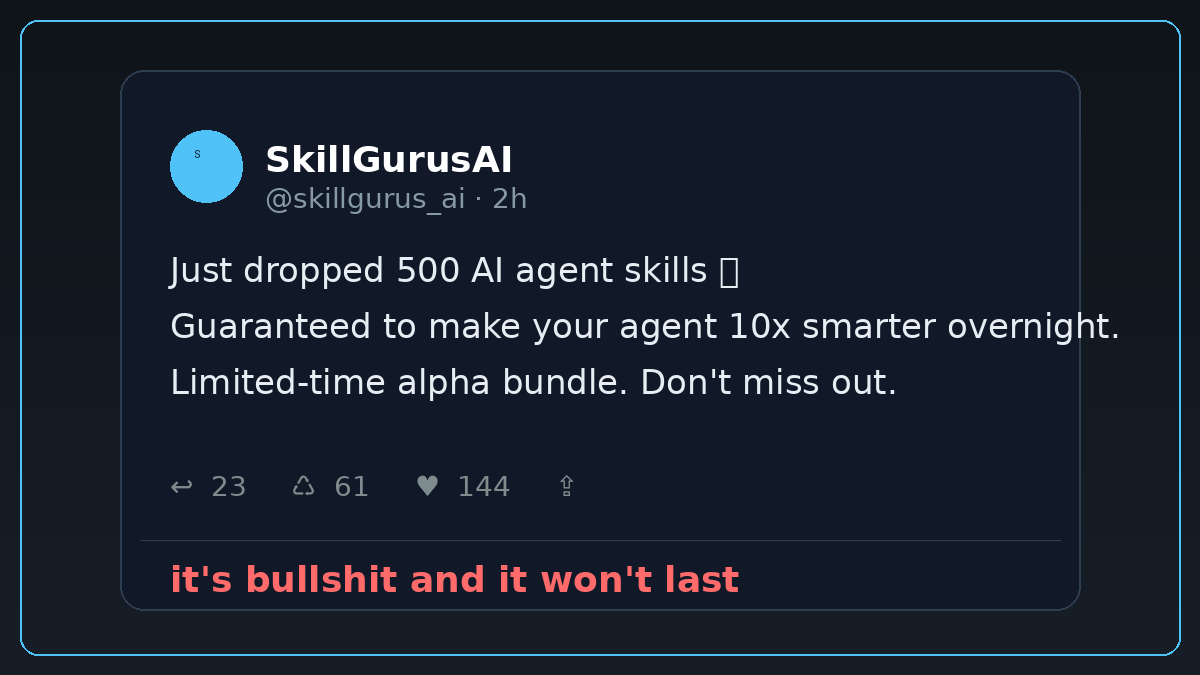
The skill-sharing we're seeing right now is either missionary (protocols evangelizing adoption), performative (open-source theater for clout), or malicious (prompt injection disguised as helpfulness). None of it is people giving away real competitive advantage. Because nobody does that.
The sharing era for valuable skills will end — or more accurately, it never really started. What people share are the marketing skills. The real ones were always staying inside.
What replaces sharing? Agent marketplaces.
Platforms like OpenAgents point the way: instead of downloading someone's skill and running it yourself, you hand work to an agent that has the skill. The skill stays proprietary. You get the output.
You're not buying the recipe. You're hiring the chef.
This is where it converges:
The Skill Economy
🔓 Public skills (missionary) → Propagate freely. Protocols compete on skill quality the way they used to compete on docs quality.
🔒 Private skills (edge) → Stay proprietary. Monetized through agent-as-a-service marketplaces, not through sharing.
🎭 Shared "skills" (performative) → Open-source theater. Looks generous, rarely contains real edge.
The models will keep getting better. They'll converge. When every agent is equally intelligent, the only question left is:
What does yours know?
Read the agent-readable version of this post, or subscribe to RSS for more.